Stefan Herheim on working with Daniele Gatti, the choice of tempi and the staging of preludes
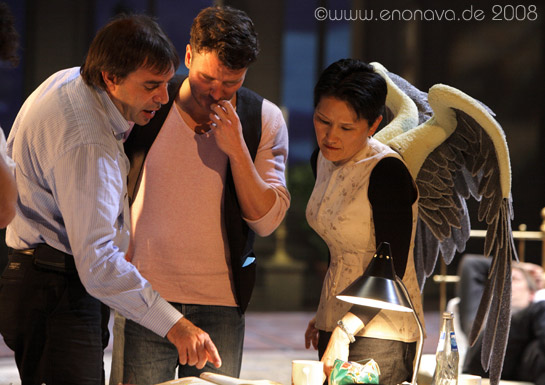
Daniele Gatti, Stefan Herheim and Mihoko Fujimura (Kundry). Photo: Enrico Nawrath / Bayreuther Festspiele
It was not easy to convince the conductor that there should be a captivating scenic action during the sacrosanct prelude to the First act of Parsifal. Also the choice of musical tempi means a lot to the instruction of singers and to Herheim's famous battery of stage decorations moving up and down, in and out of the stage during the drama.
How has the collaboration with the conductor Daniele Gatti been?
When I heard him conducting his first Parsifal in Rome (concert performance), I was somewhat surprised and startled: he was even slower than Toscanini - the first act alone lasted for well over two hours. Daniele was equally suspicious of my ideas, and for a while I was afraid that our different approaches wouldn’t be productive and that the collaboration wouldn’t work. But during the rehearsals in Bayreuth, we immediately began to communicate. Daniele saw that I felt the musical gestures totally intuitively, and that my direction corresponded with his interpretation of the score. And during the rehearsal process, I learned to understand his tempo choices and musical perspectives much better. Our collaboration turned out to be very productive, creative and we have great respect for each other.
And the question of tempi?
I still have some qualms about some of Daniele's choices of tempo and phrasing. But the tempo in itself isn’t always the determining factor. If the time frame is filled and the overall arc isn’t broken, the sound space doesn’t appear as slow. In this way, Maestro Gatti is a magician with the orchestra. And it has to be noted that it is a particular challenge to conduct at Bayreuth. Down in the half-enclosed orchestra pit, there’s quite a different sound to what reaches the hall. It’s sometimes evident that the singers are unable to hold the phrase as long as Daniele wants. But this is actually okay because of the overall tone and timbre he brings out, with an enormous range of colours and constant shifts - from extreme high tension to a complete lull - suddenly pulsing forward, and then with the sound almost dying out. This interaction is indescribably fascinating and beautiful.
The conductor Hartmut Haenchen gave one of the world's fastest Parsifals in Paris, while Daniele Gatti is among the slowest. How does the conductor's choice of tempi affect your productions?
The conductor's choice of tempi naturally has a great influence on me and my work with singers, light, video and stage technique. But, artistically, this has less to do with chronological time than with the temporal space that opens up. It has to do with the way this temporal space is filled, and thus with experienced time. People who attended Haenchen’s version of Parsifal and looked at their watches afterwards couldn’t believe that it had all gone so fast. Nevertheless, they felt that they had had a complete experience of Parsifal. And here in Bayreuth people often feel that time flies, even if the tempo is at times very slow and the performance accordingly long.
But in your Parsifal the sets move almost constantly: to and fro, in and out, up and down. In practical terms, how would a ‘fast’ Parsifal affect this staging?
It wouldn’t be possible without making technical modifications, which of course is something that could be done. Gatti has gained nearly two minutes on the Prelude between last year and this year. I can see it in the singers' movements. It all has another temperature, it works just as well, but differently.
Would a faster performance be better then?
No. But not necessarily worse. No movement in the music is random. All notes have their own legitimacy and significance. Nor are the movements on stage random, everything has a purpose and is timed according to the music. In the beginning it was a challenge for the singers to lower the pulse to Gatti’s slow tempos without losing the tension of the moment and the situation. When the pace was moved up, the singers were almost terrified. What's happening? Why is he "running" off? They now missed the slow pace that they had difficulties getting used to in the first place. Everything is relative.
Gatti was initially sceptical about the Prelude being staged, wasn’t he?
Yes, he was worried that the stage would distract the audience from the music.
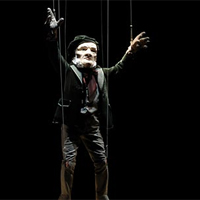
Richard Wagner as a puppet during the Prelude of Lohengrin Act 1 in Stefan Herheim's production at Staatsoper in Berlin.
Herheim's staging of the Lohengrin Prelude lead to a bitter dispute between the conductor Daniel Barenboim and Herheim when Barenboim a couple of days before the premiere insisted that the curtain should be down during the Prelude.
Do you understand that conductors would rather have this time for themselves?
If this is what it’s about then, no, I don’t understand it at all! A Prelude is not “time for the conductor”, but the opening of the door to the world of the opera performed that evening. This opening can work strictly through the auditive senses, but since in Parsifal the significant motifs appear in the prelude, I find good reason to also open the door visually and allow more than one sense to be stimulated.
So the Prelude is actually not pre-anything, but right in the middle of physical action?
And when the curtain goes up after the Prelude, no one is listening to the music anymore, is that it? My God, when you create musical theatre it’s not about competing for attention but about working together so that the audience can see the work with their ears and hear it with their eyes. To be sure, an orchestral Prelude is a musical mood-setter for the evening’s performance. You come into the theatre from the stress of everyday life and need time for auditory and mental retuning, and so on. But as the most important motifs are often established in the Prelude, I see no reason not to also establish these scenically from the first note - as long as this strengthens the overall artistic integrity of the performance. I'm not saying that in principle the Prelude should always be staged. But if you have good reasons to portray the music in the prelude, it's just the way that it’s done that you can argue against. Gatti acknowledged this and was excited about the symbiosis the staging entered into with the music.
Translated by Jonathan Scott-Kiddie
Parsifal on DVD and CD
Stefan Herheim: Parsifal - Selected Reviews and Comments
- Abendzeitung
- Agence-France Presse
- Associated Press (2009): More impressive is the thread Herheim weaves — a century of German history replete with back-projected footage of the two world wars, smoking ruins left by the fall of the Third Reich, on-stage depictions of war wounded, fleeing Jews and — toward the end — Germany as a phoenix rising from the ashes. The links are clear but effective. Sin begets misery in the knight-priest kingdom, and pulls the country into the vortex of destruction that ends only with the redemption wrought by Parsifal. Old and new are joined, and the result is an opera that is true to its roots but relates as well on the contemporary level.
- Bayreischer Rundfunk (audio)
- Berliner Zeitung
- Bloomberg: The richness and psychological depth of Herheim's images and the seamless musicality with which he and his team have knitted them together add up to an evening of breathtaking impact.
- Boulezian blog: Daniele Gatti’s reading of the score rarely drew attention to itself but contributed to the unfolding dramas in exemplary fashion. […] The richness of the Bayreuth orchestra was ever apparent, but never more so than when it finally had our full attention, during the unstaged Prelude to Act III. That evocation of hard-won passing of time can rarely have seemed more apt than in the circumstances of this production. The gradual unfolding of the score’s phrases and paragraphs was faultless. Each act was possessed both of its own character and of an array of variegation and cross-reference. And the bells sounded better than I can recall hearing them anywhere (except of course on the most venerable of old Bayreuth recordings).
- Graham Bruce (The Wagner Society in Queensland): Herheim conceived PARSIFAL as a child's dream, with all of the Freudian implications that suggests. Now if that description suggests that this was yet another production which rode rough-shod over the text and music, I must assure my readers that conceptually, visually and musically, this was an outstanding success; indeed it's been some time since goose-bumps arose on my skin as they did during this performance.
- Corriere della Sera
- Crescendo
- Le Figaro: Un Parsifal politiquement correct
- Financial Times: The performance works on so many levels that you emerge challenged and stimulated: Bayreuth at its best.
- Frankfurter Allgemeine
- The Guardian: Herheim's production continually poses the direct question of whether Wagner's own Bayreuth legacy - like the decaying world of the Grail knights in Parsifal - can ever be morally cleansed. In pursuit of an answer, Herheim takes us on a formidably ambitious journey through a dazzlingly inventive theatrical deconstruction of Parsifal, of German history, of Wagner and, above all, of the way they are woven together in Bayreuth itself.
- International Herald Tribune: The staging is grandiose, visually sensual, and scenically enthralling. The audience's attention rarely waned during the seven-hour performance, despite the slow, deliberate pace of the score as conducted by Italian Daniele Gatti. […] Herheim makes use of every modern stage technique available to him, deploying an endless succession of technological fireworks and visual provocations.
- Kurier
- Merkur-Online
- Mostly Opera: […] myriads of ideas, sufficient for several new Parsifal productions on an over-stuffed stage, downstaging both singers and music and ultimately creating confusion as opposed to enlightenment.
- New York Times: In the end, it is moving. Directors get away with half-baked ingenuities because opera plots already require suspended judgment — and because of the music. Under Daniele Gatti’s baton, the score unwinds in grave and luxurious fashion. The Bayreuth chorus is peerless, as always. Christopher Ventris, as an ardent Parsifal; Detlef Roth, the touching Amfortas; and Kwangchul Youn, a brooding Gurnemanz, make for unexpected stars. Mihoko Fujimura, notwithstanding the straining in her upper reaches, is the desperate, heartbreaking Kundry. If someone at Bayreuth could sift through Mr. Herheim’s bounty of ideas, this might yet become a great production.
- rp-online.de
- Der Spiegel
- The Stage (Penelope Turing: Herheim is tempted by adding some ‘ideas’, but emerges triumphant because this is simply a great musical performance.)
- Der Standard
- Süddeutsche Zeitung
- Tagesspiegel
- Telegraph (Rupert Christiansen, 2009): I caught the first revival of the Norwegian director Stefan Herheim's production of Parsifal. Its first two acts are among the most beautiful and complex things that I have ever seen on a stage, and I can scarcely describe their import. [...] What further distinguishes Herheim's direction is its exquisitely sensitive musicality. The endlessly shifting and meticulously choreographed imagery flows in and out of the river of Wagner's score, as it progresses from the Bismarck era to Adenauer's reconstruction, through two world wars and the Weimar Republic, showing idealism turning to militarism and religious belief to political fanaticism.
- The Wagner Journal (Barry Millington): This is one of the finest stagings of the work ever seen at Bayreuth, or anywhere else. While undeniably complex, the dramaturgy is strong, clear and focused. The stagecraft, moreover, is superb. (Review available in the printed edition.)
- Die Welt
- Westdutsche Allgemeine Zeitung: Herheims Parsifal ist vielschichtig, aber dabei nicht beliebig. Er hält eine kluge Balance zwischen Dokumentation und Traumkosmos. Und der Norweger ist ein Regisseur von großer Musikalität: Gesten und Blicke, Gänge und Verwandlungen korrespondieren punktgenau mit Wagners Musik.
- "I have noticed a tendency to the (historically) excessive since 2008 in the production on the Green Hill by Stefan Herheim, Schlingensief’s successor as director of Parsifal: as if these directors knew what wealth Wagner had left in his last opera but did not feel able to control it and make it fertile. I think we should not be too complicated, nor always think of history before and after Wagner and show it on stage. As Lars von Trier said: if we want Wagner, then Wagner is what we want." Christian Thielemann. As quoted in Christian Thielemann: My Life with Wagner (p. 249). Orion. Kindle Edition.
Scandinavian reviews
- Mystikk og begjær. Av Erling E. Guldbrandsen
- Drømmen om forløsning. Av Ståle Wikshåland
Stefan Herheim interviews
Stefan Herheim on Daniele Gatti, tempi and staging of preludes
Herheim on Parsifal: The Theatre is my Temple
Stefan Herheim links
Interviews
Peter Konwitschny: I do not consider myself a representative of the Regietheater
Alexander Meier-Dörzenbach: There is so much more than mere sentimentality to this great opera
Detlef Roth: Amfortas' Suffering is Germany's
Kasper Holten: Tannhäuser's Rome narrative is perhaps all fiction—but it is his best story ever
Lisbeth Balslev: You come to Bayreuth for the sake of art
Iréne Theorin: Isolde is incredibly intense, and that really suits me
Graham Clark: I just switched hobbies
Anne Evans: At the time I hadn’t realised what a powerful impact it made
Johanna Meier on Isolde, Bayreuth and Ponnelle
Lioba Braun on Brangäne, Bayreuth and Wagner
Stephen Gould: Tristan is the end of the line
Penelope Turing: "Heil dir, Sonne!" Meant Something in those Conditions
Daniel Slater: The creation of the self through love and death
Sharon Polyak on West-Eastern Divan Orchestra, Wagner in Israel, Bayreuth