
Richard Wagner and Wagner operas


“Every night before I go on stage I have a sense of how special is it to be at Bayreuth and how privileged I am to be part of this tradition.” (Andrew Shore)
On Wagneropera.net, opera lovers can find various content related to Wagner operas, including reviews of Bayreuth Festival performances, interviews with stage directors and Wagnerian singers, as well as reviews of recordings. The website also features news and updates about Wagnerian events and productions around the world. Additionally, you can see which Wagner recordings you need to have and read about Wagner lovers’ experiences attending the Bayreuth Festival.
Bayreuth Festival 2024
For the first time in the history of the Bayreuth Festival, there will be more female than male conductors in the pit. In 2024, Simone Young will conduct the Ring, stepping in for Philippe Jordan, who unfortunately had to cancel. The lineup for this year also includes Oksana Lyniv, Nathalie Stutzmann, Semyon Bychkov, and Pablo Heras-Casado. With Simone Young, a female conductor will lead the tetralogy in Bayreuth for the first time. Engaging her had been a longstanding aspiration for the artistic director, but prior commitments had prevented an earlier collaboration.
Richard Wagner at Deutsche Oper Berlin in the season 2023/2024

In the 2023/2024 season you can expect the entire Bayreuth Wagner – from DER FLIEGENDE HOLLÄNDER to PARSIFAL – at the Deutsche Oper Berlin in highly diverse directorial styles with internationally sought-after casts. DER RING DES NIBELUNGEN in Stefan Herheim's production continues the more than hundred-year tradition of performances of Wagner's tetralogy at Bismarckstraße and returns for three cycles in May and June 2024. The ring cycles can only be booked as packages.
Further Bayreuth works in the 23/24 season: Der fliegende Holländer, Lohengrin, Tristan und Isolde, Tannhäuser, Die Meistersinger von Nürnberg, Parsifal
Der fliegende Holländer (Dmitri Tcherniakov/ Oksana Lyniv), Bayreuth 2023

Read Sam Goodyear's review here...
Augmented Reality, Allegory, and Environmental Themes: Sam Goodyear reviews Jay Scheib’s Parsifal Production at Bayreuth 2023

Read the review here...
Tristan und Isolde – “the production that never should have been”

Conductor: Markus Poschner
Director: Roland Schwab
Stage design: Piero Vinciguerra
Costumes: Gabriele Rupprecht
Dramaturgy: Christian Schröder
Light: Nicol Hungsberg
Chorus master: Eberhard Friedrich
Video: Luis August Krawen
Tristan: Clay Hilley
Marke: Georg Zeppenfeld
Isolde: Catherine Foster
Kurwenal: Markus Eiche
Melot: Olafur Sigurdarson
Brangäne: Christa Mayer
Ein Hirt: Jorge Rodríguez-Norton
Ein Steuermann: Raimund Nolte
Junger Seemann: Siyabonga Maqungo
If Roland Schwab’s goal with his production of Tristan und Isolde were to provide a sense of escapism, then one has to say he delivered it. Sam Goodyear reviews Tristan und Isolde – “the production that never should have been”.
Sam Goodyear on Roland Schwab’s production of Tristan und Isolde, Bayreuth 2023
The Wagner Journal July 2023 issue has been published

The Wagner Journal March 2023 Issue

The March 2023 issue of The Wagner Journal has been published
The National Opera in Oslo, Norway to produce a new Ring by Christof Loy. Premiere: 2026

Christof Loy to direct a new Ring in Oslo, Norway. Die Walküre will premiere in 2026. In 2028 two complete Rings will be performed.
Singers are not announced yet.
Read more about the Christof Loy Ring
Stefan Herheim’s Ring production

Stefan Herheim’s Ring production at Deutsche Oper Berlin is finally available on DVD.
Featuring: Nina Stemme, Clay Hilley, Iain Paterson, Brandon Jovanovich, Elisabeth Teige, Albert Pesendorfer. Berlin Deutsche Opera Chorus, Berlin Deutsche Opera Orchestra. Conductor: Donald Runnicles. Stage director: Stefan Herheim. Set designer Stefan Herheim and Silke Bauer. Costume designer: Uta Heiseke. Lighting: Ulrich Niepel.
Recorded at the Deutsche Oper Berlin, 9–21 November 2021
Happy birthday, Maestro!

Happy 80th birthday to Daniel Barenboim!

The November 2022 issue of The Wagner Journal has been published
Tcherniakov Ring, Staatsoper under den Linden, Berlin

→ Tcherniakov: Das Rheingold, Staatsoper Berlin, 2022
→ Tcherniakov: Die Walküre, Staatsoper Berlin, 2022
→ Tcherniakov: Siegfried, Staatsoper Berlin, 2022
→ Tcherniakov: Götterdämmerung, Staatsoper Berlin, 2022
Bayreuth Festival 2022

The Bayreuth Festival 2022 - Reviews by Mark Berry and Sam Goodyear
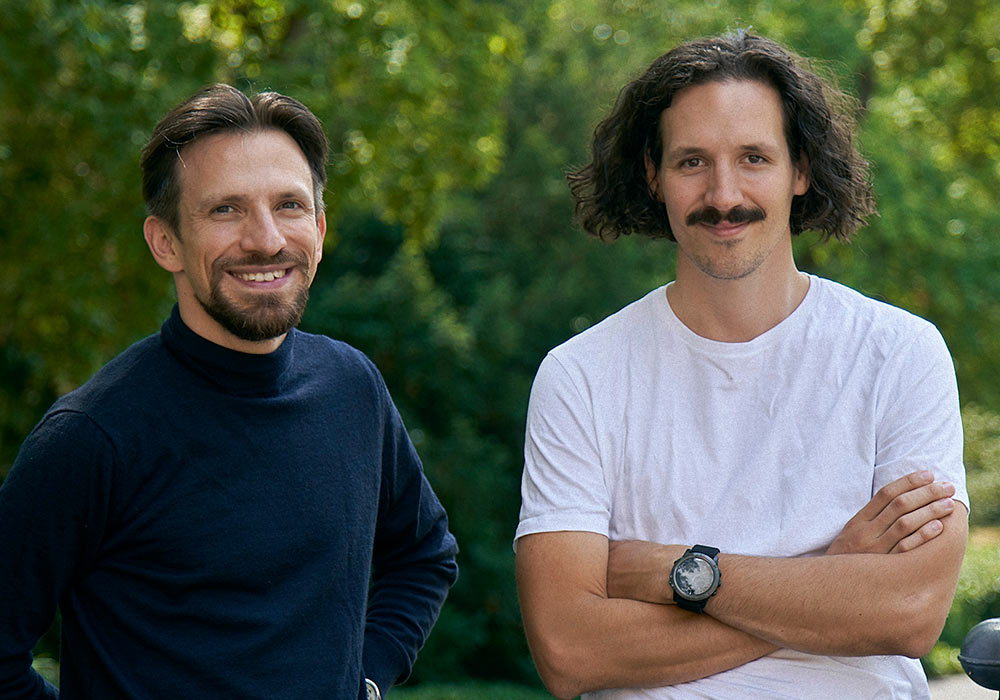
Cornelius Meister and Valentin Schwarz. (Photo: Enrico Nawrath, Bayreuter Festspiele)
→ Das Rheingold (Valentin Schwarz / Cornelius Meister) - Bayreuth Festival 2022
→ Die Walküre (Valentin Schwarz / Cornelius Meister) - Bayreuth Festival 2022
→ Siegfried (Valentin Schwarz / Cornelius Meister) - Bayreuth Festival 2022
→ Götterdämmerung (Valentin Schwarz / Cornelius Meister) - Bayreuth Festival 2022

(Photo: Enrico Nawrath, Bayreuter Festspiele)
Programme Bayreuth Festival 2023
July 2023
24 Festspiel Open Air (Conductor: Markus Poschner. Cast: Daniela Köhler, Magnus Vigilius, Olafur Sigurdarson)
25 Parsifal (Jay Scheib / Pablo Heras-Casado)
26 Das Rheingold (Valentin Schwarz / Pietari Inkinen)
27 Die Walküre (Valentin Schwarz / Pietari Inkinen)
28 Tannhäuser (Tobias Kratzer / Nathalie Stutzmann)
29 Siegfried (Valentin Schwarz / Pietari Inkinen)
30 Parsifal (Jay Scheib / Pablo Heras-Casado)
31 Götterdämmerung (Valentin Schwarz / Pietari Inkinen)
August 2023
1 Der fliegende Holländer (Dmitri Tcherniakov / Oksana Lyniv)
2 Festspiel Open Air (programme to be announced later)
3 Tristan und Isolde (Roland Schwab / Markus Poschner)
4 Der fliegende Holländer (Dmitri Tcherniakov / Oksana Lyniv)
5 Das Rheingold (Valentin Schwarz / Pietari Inkinen)
6 Die Walküre (Valentin Schwarz / Pietari Inkinen)
7 Tannhäuser (Tobias Kratzer / Nathalie Stutzmann)
8 Siegfried (Valentin Schwarz / Pietari Inkinen)
10 Götterdämmerung (Valentin Schwarz / Pietari Inkinen)
11 Der fliegende Holländer (Dmitri Tcherniakov / Oksana Lyniv)
12 Parsifal (Jay Scheib / Pablo Heras-Casado)
13 Tristan und Isolde (Roland Schwab / Markus Poschner)
14 Der fliegende Holländer (Dmitri Tcherniakov / Oksana Lyniv)
15 Parsifal (Jay Scheib / Pablo Heras-Casado)
16 Tannhäuser (Tobias Kratzer / Nathalie Stutzmann)
18 Der fliegende Holländer (Dmitri Tcherniakov / Oksana Lyniv)
19 Parsifal (Jay Scheib / Pablo Heras-Casado)
20 Tannhäuser (Tobias Kratzer / Nathalie Stutzmann)
21 Das Rheingold (Valentin Schwarz / Pietari Inkinen)
22 Die Walküre (Valentin Schwarz / Pietari Inkinen)
23 Parsifal (Jay Scheib / Pablo Heras-Casado)
24 Siegfried (Valentin Schwarz / Pietari Inkinen)
26 Götterdämmerung (Valentin Schwarz / Pietari Inkinen)
27 Parsifal (Jay Scheib / Pablo Heras-Casado)
28 Tannhäuser (Tobias Kratzer / Nathalie Stutzmann)
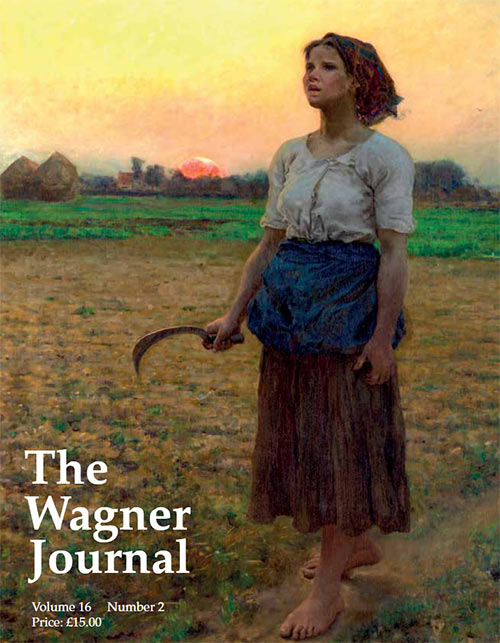
The July 2022 issue of The Wagner Journal has been published
Stefan Herheim - 3 Ring cycles at Deutsche Oper Berlin 2021/2022

The Wagner Journal - November 2021 issue

The November 2021 issue of The Wagner Journal...

The July 2021 issue (vol.15, no.2) of The Wagner Journal has been published

The Cambridge Companion to Wagner's Der Ring des Nibelungen (edited by Mark Berry and Nicholas Vazsonyi)
The Cambridge Companion to Wagner's Der Ring des Nibelungen – edited by Mark Berry, Royal Holloway, University of London, and Nicholas Vazsonyi, Clemson University, South Carolina – is an essential, interdisciplinary tool for those both familiar and unfamiliar with Wagner's Ring. It opens with a concise introduction to both the composer and the Ring, introducing Wagner as a cultural figure, and giving a comprehensive overview of the work.
Subsequent chapters, written by leading Wagner experts, focus on musical topics such as 'leitmotif', and structure, and provide a comprehensive set of character portraits, including leading players like Wotan, Brünnhilde, and Siegfried.
Further chapters look to the mythological background of the work and the idea of the Bayreuth Festival, as well as critical reception of the Ring, its relationship to Nazism, and its impact on literature and popular culture, in turn offering new approaches to interpretation including gender, race and environmentalism. The volume ends with a history of notable stage productions from the world premiere in 1876 to the most recent stagings in Bayreuth and elsewhere.

The Wagner Journal, March 2021
Ring Productions at the Bayreuth Festival
All the Ring productions at Bayreuth.
So there was much in 1876 that could never be repeated – Wagner, of course, in his full creative power and the splendid setting of Bayreuth that gave us such freedom for expression. As Rhine-maidens we played our part to the full – gay and capricious of mood at the beginning of Rheinhold and grave in our solemn warning to Siegfried in the last act of Götterdämmerung. And here I must mention that I always sang in my part in Rheingold – ‘Nur wer der Minne Macht entsagt’ never versagt as I always heard it sung later. I drew Levi’s attention to this in 1884 at Munich, when he wanted me to sing ‘versagt’ instead of ‘entsagt’.
Lilli Lehmann in her memoirs

"People sometimes complain that Wagner operas are too long, that they get stiff and sore about 10.30 because they have rushed in to hear one of his works straight from work and are not properly prepared for listening to his music. The audience, as much as the artists, must be prepared for a performance."
(Benjamin Britten to Alan Blyth, Gramophone)

"Bayreuth’s special and much praised acoustic is actually only fully functional in Parsifal. It is certainly also one of the reasons why Wagner uses a style that is far closer to chamber music for this work. In the earlier pieces, composed for other stages, but also in the Ring, which elaborates far denser structures than Parsifal, and especially in Die Meistersinger too, one is aware that the Bayreuth acoustic is by no means ideal since it blurs the contrapuntal element of these works."
Hartmut Haenchen
"I was bowled over. It was the year after Wieland Wagner had died; to be able to see his productions was a total knock-out. These bare stagings, where everything was done with lighting. The light changed with the music, and the shadows and patterns seemed as archetypal as the music itself. Nobody had done that on the stage before. I thought it was extraordinary and wonderful."
(Patrick Carnegy to The Guardian)
The Bayreuth Festival 2019

Stephen Gould and Petra Lang. (Photo: Enrico Nawrath/Bayreuther Festspiele.)
Mark Berry reviews: Tristan und Isolde (Katharina Wagner / Christian Thielemann)
Mark Berry reviews: Lohengrin (Yuval Sharon / Christian Thielemann)
Mark Berry reviews: Tannhäuser (Tobias Kratzer / Christian Thielemann) - Bayreuth Festival 2019

(Photo: Enrico Nawrath/Bayreuther Festspiele)
The First Commercial Recording of Wagner’s Götterdämmerung - now remastered and released by Decca

Siegfried - Set Svanholm
Gunther - Waldemar Johnsen
Alberich - Per Grönneberg
Hagen - Egil Nordsjø
Brünnhilde - Kirsten Flagstad
Gutrune · Third Norn - Ingrid Bjoner
Waltraute · First Norn - Eva Gustavson
Woglinde - Unni Bugge-Hanssen
Wellgunde · Second Norn - Karen Marie Flagstad
Flosshilde - Beate Asserson
Opera Chorus,
Oslo Philharmonic Orchestra,
Norwegian State Radio Orchestra
Conductor: Øivin Fjeldstad
FIRST CD RELEASE ON DECCA. REMASTERED FROM THE ORIGINAL TAPES.
First commercial recording of Wagner’s Götterdämmerung
Kirsten Flagstad’s farewell to the role she made her own: a rarely reissued, newly remastered and extensively documented monument in the history of Wagner on record.
As the first commercial recording of Wagner’s Götterdämmerung this set would have lasting significance even without the presence of its undoubted star, the Norwegian soprano Kirsten Flagstad in her signature role of Brünnhilde. In fact Flagstad had retired from the operatic stage in 1953, just shy of her 58th birthday, with her voice still largely intact when she was persuaded to return to the heroine of the Ring one final time and in propitious circumstances: live performances of an act at a time, generously spaced by a few days at a time, working with a fellow-Norwegian conductor she knew well, and a partner in the role of Siegfried who had developed a musical understanding with her over the course of decades. On her death in December 1962, Set Svanholm paid tribute to ‘the warm dark gold in her voice’, the immense physical presence she brought to the stage and ‘an expression in the performance whereby the greatness of the simplicity became overwhelming’.
Yuval Sharon's new Lohengrin production at Bayreuth

Yuval Sharon's new Lohengrin production at Bayreuth. Photo: Enrico Nawrath / Bayreuther Festspiele
"I've learned to ignore acoustics because I have to sing in so many different environments. But the acoustic here really is better than anywhere else. When you start to sing, you have the feeling that the voice is just spreading freely in the auditorium. In other opera houses you have to sing over the orchestra, which is positioned between you and the audience. With its covered orchestra pit, Bayreuth is a luxury." (Piotr Beczala to DW.com)
Pierre Audi directs Parsifal at the Bavarian State Opera, Munich

Photo: Ruth Walz / Bayrerische Staatsoper
Singing at Bayreuth
"What’s wonderful here [in Bayreuth] is that you can hear yourself both at the front and the back of the stage. It isn’t always like this in concert halls and opera houses. There can be a very dry acoustic, but that isn’t the case at Bayreuth. Sometimes the orchestra is incredibly loud and that’s when it’s important to take care not to exert yourself too much. You have to be focused. It’s the conductor’s job to quieten the orchestra if it’s too loud. Singing too loudly is the worst thing you can do." (Irène Theorin in interview with Per-Erik Skramstad)
"People who say that Wagner knew exactly how he wanted his works produced - so what right have you to stage the Ring on Mars or down a salt mine - are wrong," he says. "Wagner was precise [in his stage directions] because the theatrical world into which he launched his works was a total mess, and the quality was very poor. The reason he took such trouble was defensive: it wasn't so much that he knew what he wanted, but he jolly well knew what he didn't want."
Patrick Carnegy to The Guardian

Sam Goodyear interviews Kevin Clarke about Siegfried Wagner's homosexuality and its influences on Wagner performance history and the Bayreuth Festival

CASTORF / WAGNER Der Ring des Nibelungen 2013-2017: Bilingual book (french/german) about Frank Castorf's Ring production at Bayreuth edited by Guy Cherqui and David Verdier (Wanderer, Geneva) With essays by, and interviews of, the main architects of this project, this book aims for an in-depth analysis of the main lines of enquiry of a work that has already assured its place among the greatest Bayreuth productions. Frank Castorf’s theater has found in Wagner an ideological and polemic sounding board that echoes our most extreme issues of the day. The second part of the book is a lexicon of characters, themes and references that offers both readers and viewers points of orientation in the Castorfian Gesamtkunstwerk.CASTORF / WAGNER Der Ring des Nibelungen 2013-2017: Bilingual book (French/German)
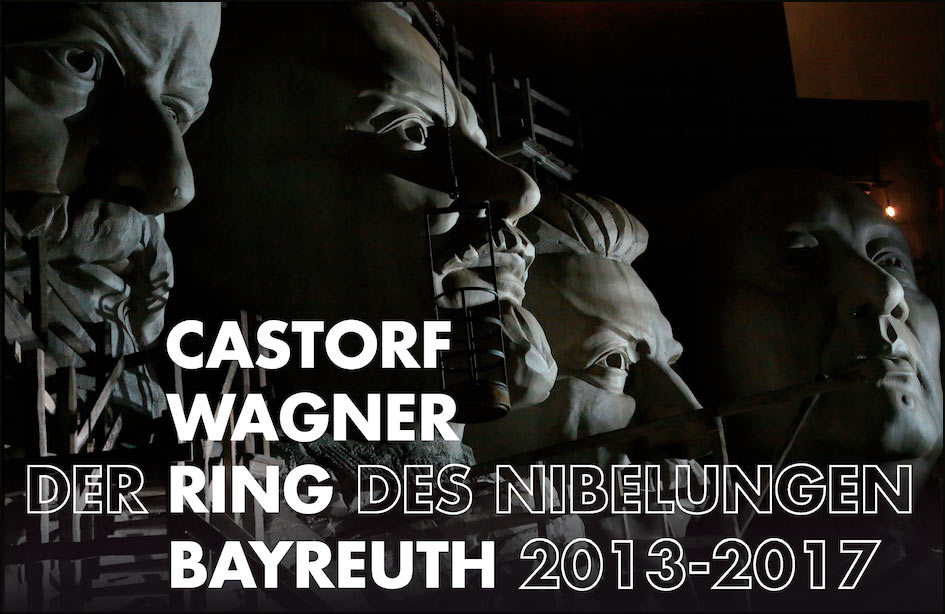
Essays and Interviews Katharina Wagner (artistic director, Bayreuth), Frank Castorf (stage director), Aleksandar Denic (stage designer), Patric Seibert (assistant/actor), Adriana Braga Peretzki (costume designer), Wolfgang Koch (Wotan), Nadine Weissmann (Erda)...
Ring ABC
62 entries by Guy Cherqui and David Verdier
Specifics 26x17 cm 384 pages 200+ color plates, most of them exclusive photos
La Pommerie Éditions in collaboration with the Wanderer website ISBN 978-2-9564912-0-0 Info castorf.ringbook@wanderersite.com
More info here!
Mark Berry: Die Meistersinger von Nürnberg (Kosky/Jordan) Sam Goodyear: Die Meistersinger von Nürnberg (Kosky/Jordan) Mark Berry: Parsifal (Laufenberg/Haenchen) Mark Berry: Das Rheingold (Castorf/Janowski) Mark Berry: Die Walküre (Castorf/Janowski) Mark Berry: Siegfried (Castorf/Janowski) Mark Berry: Götterdämmerung (Castorf/Janowski) The Bayreuth Festival 2017 Reviews
The Bayreuth Festival, 2016

Das Rheingold (Castorf / Janowski), Bayreuth Festival, 2016
Die Walküre (Castorf / Janowski), Bayreuth Festival, 2016
Siegfried (Castorf / Janowski), Bayreuth Festival, 2016
Götterdämmerung (Castorf / Janowski), Bayreuth Festival, 2016
Tristan und Isolde (K. Wagner / Thielemann), Bayreuth Festival, 2016
Parsifal (Laufenberg / Haenchen), Bayreuth Festival, 2016
The thing I love about Wagner's work is the subliminal, the erotic, the visionary factor - and that's how I stage things as well. I try to acquire an awareness of the archetypes, images and symbols and bring them to the surface; the music was composed to be interpreted that way. Wagner has nothing to do with realism or naturalism, but his work rather expresses the mental landscape of a man, treats sections of his personality that may be in conflict with one another - and people who may seem real but are in actual fact products of his dreams, which he can use or not as he pleases. It has to do with the strata of a personality.
David Alden in conversation with Peter Jonas
Stefan Herheim Interviews
Stefan Herheim on Parsifal, Bayreuth and Daniele Gatti
Wagnerians recommend

The best Richard Wagner CDs and DVDs
Katharina's Tristan an Artistic Triumph

E.E. Guldbrandsen on the new Tristan
One-dimensional and unmoving Dutchman

E.E. Guldbrandsen reviews the Dutchman
Castorf's Rheingold at Bayreuth 2014

Mark Berry reviews Das Rheingold (2014)
Peter Konwitschny on Regietheater

"I am no representative of the Regietheater"
Neuenfels' Lohengrin at Bayreuth 2014

Daniel Barenboim: Complete Wagner Operas

Daniel Barenboim's Wagner on 34 CD's
Frank Castorf: Ring at Bayreuth 2013

There Will Be Blood: Frank Castorf has entered the Ring
Detlef Roth on Amfortas and Stefan Herheim's Parsifal production at Bayreuth

Interview with Detlef Roth in Bayreuth
Lioba Braun on Bayreuth

Lioba Braun interview: Brangäne, Bayreuth and Isolde
My Bayreuth Experience

Visitors tell about their Bayreuth Festival experience
Johanna Meier in Bayreuth

"I never sang Liebestod from the orchestra pit"
Iréne Theorin in Bayreuth

"Isolde is incredibly intense, and that really suits me"
Anne Evans in Bayreuth

Anne Evans talks about Brünnhilde and Bayreuth
New triumph for Bychkov

Tannhäuser at ROH - a musical triumph
Mark Berry at Bayreuth 2012

Stefan Herheim: Parsifal
Neuenfels: Lohengrin
Gloger's new Dutchman
Wagner makes Wagner

Katharina's 2010 Meistersinger gets interesting, but too late
Herheim's Parsifal 2008

Music theatre between dream and reality
Baumgarten's Tannhäuser 2011

Mark Berry sees no evidence of Baumgarten having engaged with the score at all
William Kinderman: Wagner's Parsifal

Germán A. Bravo-Casas appraises the new book on Wagner's Parsifal
Said about Richard Wagner
"People who say that Wagner knew exactly how he wanted his works produced - so what right have you to stage the Ring on Mars or down a salt mine - are wrong," he says. "Wagner was precise [in his stage directions] because the theatrical world into which he launched his works was a total mess, and the quality was very poor. The reason he took such trouble was defensive: it wasn't so much that he knew what he wanted, but he jolly well knew what he didn't want."
Patrick Carnegy to The Guardian
“Conducting Tristan was another epiphany. I became a hopeless Wagner nut and it opened up a completely new world to me. There is this unique thing about Wagner, and that’s time management. The way he can create and alter time through a couple of hours. Not only create it, but also sustain it and keep it alive with very simple means. And in mature Wagner, the whole idea of constant recycling of material, and very little material. I mean, ‘Parsifal’ has nothing: a couple of chords. And he spins all that out of them.”
Esa-Pekka Salonen to Newcity Music
Always we seem to come back to Wagner though. Of course, Wagner is a magnificent composer: the music is incredible. Whatever other music I do, coming back to Wagner is like coming home.
John Tomlinson in conversation with Mark Berry
Wagner audiences are special, I think. It’s their music – but in a positive way; it’s a passion.
René Pape on Wagner audiences
The thing I love about Wagner's work is the subliminal, the erotic, the visionary factor - and that's how I stage things as well. I try to acquire an awareness of the archetypes, images and symbols and bring them to the surface; the music was composed to be interpreted that way. Wagner has nothing to do with realism or naturalism, but his work rather expresses the mental landscape of a man, treats sections of his personality that may be in conflict with one another - and people who may seem real but are in actual fact products of his dreams, which he can use or not as he pleases. It has to do with the strata of a personality.
David Alden in conversation with Peter Jonas
I am used to seeing you respect people only if and as long as they can be of use to you. A person no longer exists for you when their usefulness is over. You know nothing of gratitude for the past: All that is merely an infernal obligation! It has always been so – towards Brockhaus, the King, Lüttichau, Pusinelli, Tichatschek, and everyone else who has helped you in one way or another. Whilst I greatly love and esteem your talent, it is just the opposite with regard to your character. Since your last letter the first sign of life you give Johanna is - lend me a thousand thalers! A mere trifle!
Johanna's father Albert 1853 (Derek Watson: Richard Wagner - A Biography, p 131)
Such demoniac personalities cannot be judged by ordinary standards. They are egoists of the first water, and must be so, or they could never fulfil their mission.
Heinrich Porges (Derek Watson: Richard Wagner - A Biography, p 131)
I like Wagner’s music better than any other music. It is so loud that one can talk the whole time, without people hearing what one says.
Oscar Wilde, The Picture of Dorian Gray
Stefan Herheim interviews
Stefan Herheim on Daniele Gatti, tempi and staging of preludes
Herheim on Parsifal: The Theatre is my Temple
Stefan Herheim links
Stefan Herheim: Parsifal - Selected Reviews and Comments
- Abendzeitung
- Agence-France Presse
- Associated Press (2009): More impressive is the thread Herheim weaves — a century of German history replete with back-projected footage of the two world wars, smoking ruins left by the fall of the Third Reich, on-stage depictions of war wounded, fleeing Jews and — toward the end — Germany as a phoenix rising from the ashes. The links are clear but effective. Sin begets misery in the knight-priest kingdom, and pulls the country into the vortex of destruction that ends only with the redemption wrought by Parsifal. Old and new are joined, and the result is an opera that is true to its roots but relates as well on the contemporary level.
- Bayreischer Rundfunk (audio)
- Berliner Zeitung
- Bloomberg: The richness and psychological depth of Herheim's images and the seamless musicality with which he and his team have knitted them together add up to an evening of breathtaking impact.
- Boulezian blog: Daniele Gatti’s reading of the score rarely drew attention to itself but contributed to the unfolding dramas in exemplary fashion. […] The richness of the Bayreuth orchestra was ever apparent, but never more so than when it finally had our full attention, during the unstaged Prelude to Act III. That evocation of hard-won passing of time can rarely have seemed more apt than in the circumstances of this production. The gradual unfolding of the score’s phrases and paragraphs was faultless. Each act was possessed both of its own character and of an array of variegation and cross-reference. And the bells sounded better than I can recall hearing them anywhere (except of course on the most venerable of old Bayreuth recordings).
- Graham Bruce (The Wagner Society in Queensland): Herheim conceived PARSIFAL as a child's dream, with all of the Freudian implications that suggests. Now if that description suggests that this was yet another production which rode rough-shod over the text and music, I must assure my readers that conceptually, visually and musically, this was an outstanding success; indeed it's been some time since goose-bumps arose on my skin as they did during this performance.
- Corriere della Sera
- Crescendo
- Le Figaro: Un Parsifal politiquement correct
- Financial Times: The performance works on so many levels that you emerge challenged and stimulated: Bayreuth at its best.
- Frankfurter Allgemeine
- The Guardian: Herheim's production continually poses the direct question of whether Wagner's own Bayreuth legacy - like the decaying world of the Grail knights in Parsifal - can ever be morally cleansed. In pursuit of an answer, Herheim takes us on a formidably ambitious journey through a dazzlingly inventive theatrical deconstruction of Parsifal, of German history, of Wagner and, above all, of the way they are woven together in Bayreuth itself.
- International Herald Tribune: The staging is grandiose, visually sensual, and scenically enthralling. The audience's attention rarely waned during the seven-hour performance, despite the slow, deliberate pace of the score as conducted by Italian Daniele Gatti. […] Herheim makes use of every modern stage technique available to him, deploying an endless succession of technological fireworks and visual provocations.
- Kurier
- Merkur-Online
- Mostly Opera: […] myriads of ideas, sufficient for several new Parsifal productions on an over-stuffed stage, downstaging both singers and music and ultimately creating confusion as opposed to enlightenment.
- New York Times: In the end, it is moving. Directors get away with half-baked ingenuities because opera plots already require suspended judgment — and because of the music. Under Daniele Gatti’s baton, the score unwinds in grave and luxurious fashion. The Bayreuth chorus is peerless, as always. Christopher Ventris, as an ardent Parsifal; Detlef Roth, the touching Amfortas; and Kwangchul Youn, a brooding Gurnemanz, make for unexpected stars. Mihoko Fujimura, notwithstanding the straining in her upper reaches, is the desperate, heartbreaking Kundry. If someone at Bayreuth could sift through Mr. Herheim’s bounty of ideas, this might yet become a great production.
- rp-online.de
- Der Spiegel
- The Stage (Penelope Turing: Herheim is tempted by adding some ‘ideas’, but emerges triumphant because this is simply a great musical performance.)
- Der Standard
- Süddeutsche Zeitung
- Tagesspiegel
- Telegraph (Rupert Christiansen, 2009): I caught the first revival of the Norwegian director Stefan Herheim's production of Parsifal. Its first two acts are among the most beautiful and complex things that I have ever seen on a stage, and I can scarcely describe their import. [...] What further distinguishes Herheim's direction is its exquisitely sensitive musicality. The endlessly shifting and meticulously choreographed imagery flows in and out of the river of Wagner's score, as it progresses from the Bismarck era to Adenauer's reconstruction, through two world wars and the Weimar Republic, showing idealism turning to militarism and religious belief to political fanaticism.
- The Wagner Journal (Barry Millington): This is one of the finest stagings of the work ever seen at Bayreuth, or anywhere else. While undeniably complex, the dramaturgy is strong, clear and focused. The stagecraft, moreover, is superb. (Review available in the printed edition.)
- Die Welt
- Westdutsche Allgemeine Zeitung: Herheims Parsifal ist vielschichtig, aber dabei nicht beliebig. Er hält eine kluge Balance zwischen Dokumentation und Traumkosmos. Und der Norweger ist ein Regisseur von großer Musikalität: Gesten und Blicke, Gänge und Verwandlungen korrespondieren punktgenau mit Wagners Musik.
- "I have noticed a tendency to the (historically) excessive since 2008 in the production on the Green Hill by Stefan Herheim, Schlingensief’s successor as director of Parsifal: as if these directors knew what wealth Wagner had left in his last opera but did not feel able to control it and make it fertile. I think we should not be too complicated, nor always think of history before and after Wagner and show it on stage. As Lars von Trier said: if we want Wagner, then Wagner is what we want." Christian Thielemann. As quoted in Christian Thielemann: My Life with Wagner (p. 249). Orion. Kindle Edition.
Scandinavian reviews
- Mystikk og begjær. Av Erling E. Guldbrandsen
- Drømmen om forløsning. Av Ståle Wikshåland
R.I.P. Kurt Moll (1938-2017)

One of the truly great Wagner voices, Kurt Moll, is dead.
> Obituary (Bayerische Staatsoper)


