Parsifal
Richard Wagner completed Parsifal in 1882. The same year it was premiered in the re-opening of the Bayreuth Festival. Parsifal was the only opera production that was played at the Festival in 1882. It was performed 16 times.
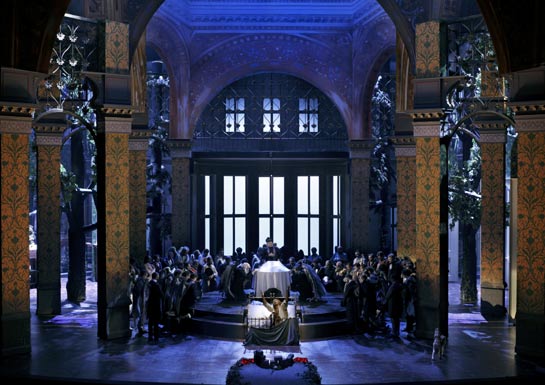
Parsifal - Stefan Herheim's production at Bayreuth.
Parsifal was produced in the following cities the first years after the world premiere in Bayreuth on 26 July 1882
Richard Wagner ordered Parsifal was to be performed no other place than the Bayreuth Festival. For 30 years Parsifal could not be performed outside Bayreuth.
| 1883 | Bayreuth |
| 1884 | Bayreuth |
| 1886 | Bayreuth |
| 1888 | Bayreuth |
| 1889 | Bayreuth |
| 1891 | Bayreuth |
| 1892 | Bayreuth |
| 1894 | Bayreuth |
| 1897 | Bayreuth |
| 1899 | Bayreuth |
| 1901 | Bayreuth |
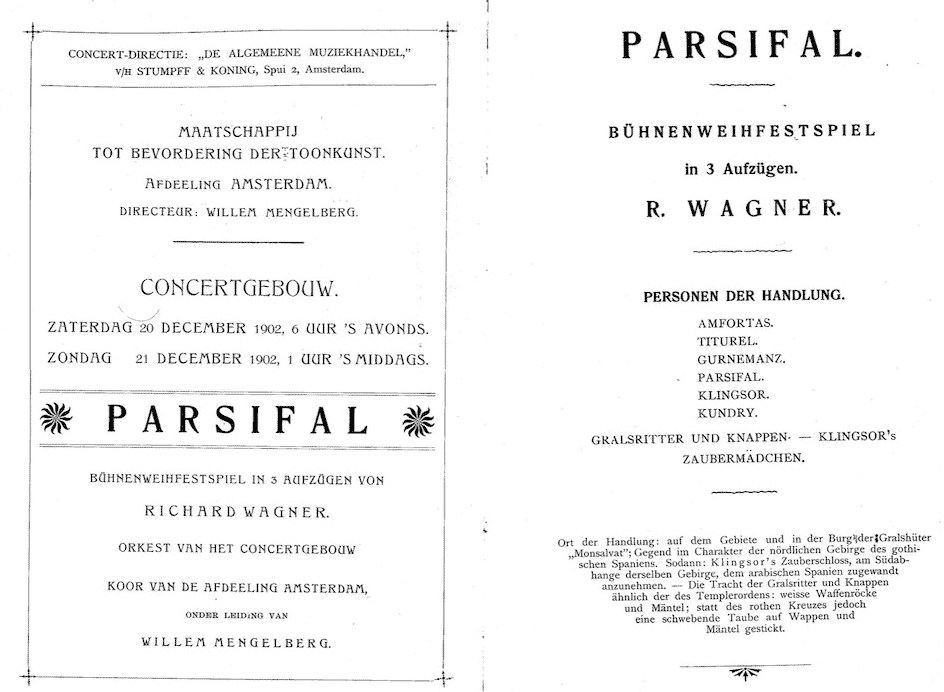
| 1902 | Bayreuth |
 |
|
| 1903 | Paris (concert performance of highlights) Milano (La Scala) (concert performance of highlights) New York (Metropolitan Opera), complete |
| 1904 | Bayreuth |
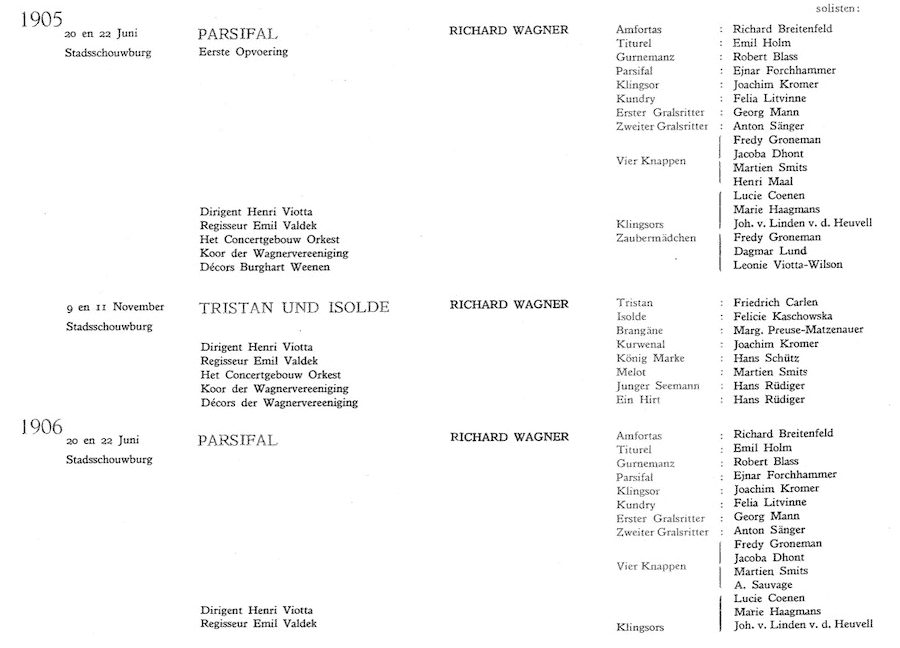
| 1905 | Amsterdam (20 & 22 June): Complete scenic performance Concertgebouworkest/Viotta (org. by Wagner Society Amsterdam) The first scenic performance in Europa outside Bayreuth (the second worldwide after New York) |
 |
|
| 1906 | Bayreuth Amsterdam (20 & 22 June): Complete scenic performance Concertgebouworkest/Viotta (org. by Wagner Association Amsterdam) |
| 1908 | Bayreuth Amsterdam (25 & 27 June): Complete scenic performance Concertgebouworkest/Viotta (org.by Wagner Association Amsterdam) |
| 1909 | Bayreuth |
| 1911 | Bayreuth |
| 1912 | Bayreuth Amsterdam (18 & 20 May): Complete scenic performance Concertgebouworkest/Viotta (org.by Wagner Associarion Amsterdam) |
| 1913 | Monte Carlo Zürich |
| 1914 | Barcelona and 40 other theatres only in the first
month of the year Bayreuth |
Thanks to Leo Cornelissen, Chairman of the Wagner Association Netherlands & the Richard Wagner Foundation Netherlands, for additional information!
Parsifal at the Bayreuth Festival. Directed by Uwe Eric Laufenberg. Reviews and comments.
- Anthony Tommasini: A Sublime and Provocative ‘Parsifal’ at Bayreuth
- Mark Ronan: Parsifal at Bayreuth, review: 'a triumph'
- A.J. Goldmann, The Forward: No Redemption For Wagner’s ‘Parsifal’ in Bayreuth
- Shirley Apthorp: Parsifal, Bayreuth Festival, Germany — ‘A washout’
- Bayreuth: Parsifal 2016 - Some Thoughts (The Wagnerian)
- Bayreuth Festival's 'Parsifal,' set in IS-occupied Iraq, railed as provincial
- Laufenberg spricht im Interview über „Parsifal“ in Bayreuth

Foto: Enrico Nawrath/Bayreuther Festspiele
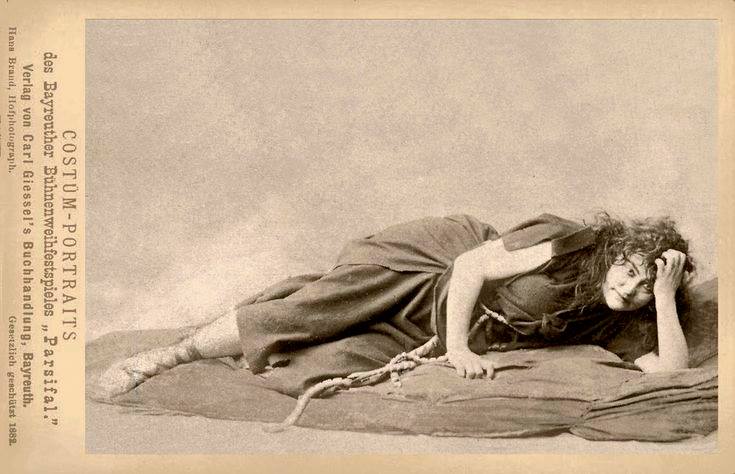
Amalie Materna as Kundry in Parsifal, Bayreuth, 1882.
Richard Wagner in Sicily
Wagner went to Palermo, Sicily, to orchestrate Parsifal Act 3. He arrived at Hôtel des Palmes (now: Grand Hotel Et Des Palmes), on 5 November 1881 with his family. Although constantly struggling with chest spasms, Wagner was inspired by the beauty of Palermo and its surrounding, especially the cathedral (Duomo) in Monreale.
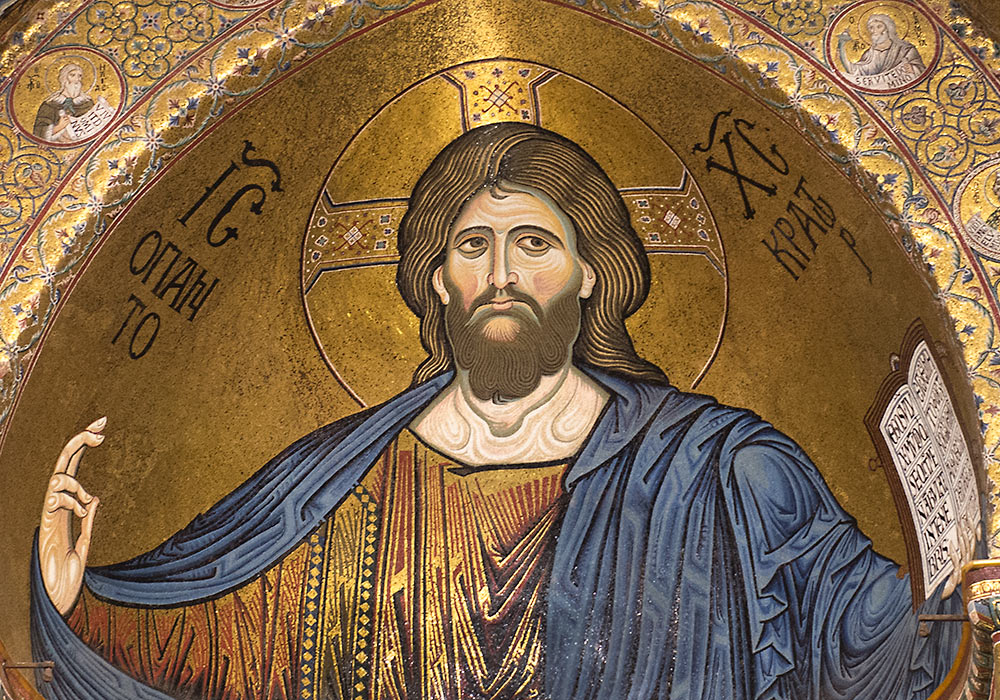
He works and goes for a walk in the garden before lunch, but at table I can already see he is in an ill humor, and the champagne he orders does not cheer him up. I can think of no reason for it, except that his work is absorbing him. However, we drive to Monreale and delight in the splendid cathedral, feeling ourselves transported back into the spirit of that distant time as we gaze on this ideal representation of it.
(Cosima Wagner’s Diaries)
13 January 1882
On 13 January 1882 the orchestration of Parsifal is completed!
Returning home, I find R. very run down, and at lunch he even leaves the table for a while, but he soon returns and proposes the toast very cordially. After lunch we visit a house which has been offered us. He then works, and in the evening, in honor of Jouk., the chorus from Die Feen is played, then the witch's ballad (sung by R.) and the Overture to Die Feen. During the last of these R. goes out, I go to see what he is doing – he is putting the finishing touches on his score: "It gave me no rest," he says. The splendid sounds of the Tannhäuser march ring out, he comes in, and – all is completed! With this, as with all his other works, he had feared being interrupted by death – that is what he told us at lunch today! […] We drink to Parsifal. Our friends depart later than usual, we stay up, R. and I, and talk of the various completions (Tristan, Msinger –), and of life in general, and go off to bed in a mood of exaltation and peace. – A few more things I have to tell about this evening; first that R. told us the story behind his first ballad (boy and swan). Then, that he spoke about the orchestration of Parsifal; the wind instruments would complain, he said, but when he recalled how, in Martha, for instance, the four horns are used time and again in the stupidest way, then he felt comforted. – He tells me that the A-monor chord (as Kundry falls to the ground) will make an impression on me; the terror of sanctity flows from it, and it will have to be very beautifully played, he says.
(Cosima Wagner’s Diaries)
Read more about the months the Wagner family stayed in Sicily here
Cast 26 July 1882 (World Premiere)
Conductor Hermann Levi
Parsifal Hermann Winkelmann
Kundry Amalie Materna
Gurnemanz Emil Scaria
Amfortas Theodor Reichmann
Klingsor Karl Hill
Titurel August Kindermann
Two Grail Knights Anton Fuchs and Eugen Stumpf
Four Esquires Hermine Galfy, Mathilde Keil,
Max Mikorey,
Adolf von Hübbenet
Six Flowermaidens Pauline Horson, Johanna Meta,
Carrie Pringle,
Johanna André, Hermine Galfy,
Luise Belce
Voice from Above, Eine Stimme Sophie Dompierre
Parsifal (complete) timings
| 3.38 | Pierre Boulez, Bayreuth 1970 |
| 3.44 | Clemens Krauss, Bayreuth 1953 (Jonathan Brown has 3.52) |
| 3.49 | Pierre Boulez, Bayreuth 1966 |
| 3.55 | Hartmut Haenchen, Copenhagen 22 March 2012 |
| 3.58 | Wilhelm Furtwängler, Milano 1951 |
| 4.02 | Christian Thielemann, recorded at Staatsoper, Wien in June 2005 (Deutsche Grammophon) |
| 4.04 | Herman Levi, Bayreuth 1882 |
| 4.08 | Michael Balling, Bayreuth 1904 |
| 4.10 | Hans Knappertsbusch, Bayreuth 1962 |
| 4.12 | Wilhelm Furtwängler Bayreuth 1936 |
| 4.15 | Felix Mottl, Bayreuth 1888 |
| 4.17 | Herbert von Karajan (1981, Deutsche Grammophon) |
| 4.19 | Anton Seidl, Bayreuth 1897 |
| 4.22 | Siegfried Wagner, Bayreuth 1909 |
| 4.23 | Fischer, Bayreuth 1882 |
| 4.23 | Hans Knappertsbusch, Bayreuth 1952 |
| 4.25 | Armin Jordan (Hans-Jürgen Syberberg's Parsifal film, 1982) (according to the cover) |
| 4.27 | Karl Muck, Bayreuth 1901 |
| 4.28 | Hans Knappertsbusch, Bayreuth 1954 |
| 4.29 | Kaehler, Bayreuth 1924 |
| 4.33 | Hans Knappertsbusch, Bayreuth 1951 |
| 4.33 | James Levine, Bayreuth 1990 |
| 4.42 | Arturo Toscanini, Bayreuth 1931 |
Sources: Jonathan Brown (Great Wagner Conductors), Derrick Everett, Per-Erik Skramstad, Hartmut Haenchen.
"The Master has already composed Parsifal to be very slow, so one doesn't need to add to this by also conducting it slowly." (Richard Strauss to the orchestra during rehearsals)
Timings Parsifal Vorspiel / Prelude Act 1
| 10'12" | Herbert Kegel, Leipzig Radio Symphony Orchestra, 1978 |
| 10'23" | Gustav Kuhn, Tiroler Festspiele, 2006 |
| 10'27" | Pierre Boulez, Bayreuth, 1970 (Deutsche Grammophon) |
| 10'57" | Kirill Petrenko, Bayerische Staatsoper, München. Premiere 28 June 2018 |
| 11'03" | Christian Thielemann, recorded at Staatsoper, Wien in June 2005 (Deutsche Grammophon) |
| 11'05" | Bruno Walter, Royal Philharmonic Orchestra (From the Album Orchestral Music - Beethoven, L. Van / Mendelssohn, Felix / Weber, C.M. Von (Studio Recordings - 1920's and 30's, Vol. 1) (Walter) (1924-1927)) |
| 11'08" | Kirill Petrenko, Bayerische Staatsoper 8 July 2018 |
| 11'25" | Bernard Haitink, Opernhaus Zürich, April 2007 (DVD) |
| 11'26" | Horst Stein, Bayreuth, 24 June - 15 July 1981 (DVD) |
| 11'35" | Erich Leinsdorf, SWR Sinfonieorchester (No year) |
| 11'40" | Kent Nagano, Baden-Baden, 6 and 8 August 2004 (DVD) |
| 11'50" | Hans Knappertsbusch, Bayreuth, 1958 |
| 11'56" | Hans Knappertsbusch, Bayreuth, 1963 |
| 11'57" | Hans Knappertsbusch, Bayreuth, 1962 |
| 12'00" | Hartmut Haenchen, Amsterdam, 1993 |
| 12'00" | Hartmut Haenchen, Paris, 2008 |
| 12'03" | Armin Jordan (Hans-Jürgen Syberberg's Parsifal film, 1982) |
| 12'03" | Hans Knappertsbusch, Bayreuth, 1964 |
| 12'05" | Herbert Von Karajan, Wiener Staatsoper 1961 |
| 12'07" | Clemens Krauss, Bayreuth, 1953 |
| 12'07" | Hartmut Haenchen, Copenhagen, 2012 |
| 12'07" | Jun Märkl, Semperoper Dresden, 19.Februar 2006 |
| 12'08" | Hans Knappertsbusch, Bayreuth, 1959 |
| 12'08" | Hartmut Haenchen, Brüssel, 2011 |
| 12'15" | Jaap van Zweden, Radio Philharmonic Orchestra. Concert performance. |
| 12'15" | Hans Knappertsbusch, Bayreuth, 1960 |
| 12'24" | Philippe Jordan, Bayreuth 2012 |
| 12'31" | Hans Knappertsbusch, Bayreuth, 1961 |
| 12'32" | Hans Knappertsbusch, Bayreuth, 1956 |
| 12'41" | Valery Gergiev, Marinski Orchestra 2010 (Marinskilabel) |
| 12'47" | Hans Knappertsbusch, Bayreuth, 1957 |
| 12'47" | Daniele Gatti, Metropolitan Opera, 2 March 2013, live on BBC Radio 3 |
| 12'59" | Felix Mottl, Freiburg, 1907, piano roll |
| 13' | Richard Wagner, Bayreuth, 25 December 1878 (Voss: Die Dirigenten der Bayreuther Festspiele) |
| 13'03" | Otto Klemperer, Philharmonia, 1960 |
| 13'06" | Arturo Toscanini, NBC Symphony, 1940 |
| 13'15" | Hans Knappertsbusch, Bayreuth, 1952 |
| 13'18" | Daniele Gatti, Bayreuth, 2010 (Stefan Herheim's Parsifal production). In 2008 Gatti conducted the prelude one minute slower. |
| 13'29" | Hans Knappertsbusch, Bayreuth, 1954 (Melodram release timing. Seven Seas has 13'15" and Tara 13'35") |
| 13'47" | Daniel Barenboim, Berliner Philharmoniker, 1989-90. Available on Daniel Barenboim: Complete Wagner Operas (34 CD) |
| 13'51" | Reginald Goodall (EMI - 1984) |
| 13'53" | Hans Knappertsbusch, Berlin, 1943 |
| 13'57" | Hans Knappertsbusch, Bayreuth, 31 July 1951 |
| 13'59" | Fritz Busch, Buenos Aires, 1936 |
| 14'03" | Wilhelm Furtwängler, Berlin, 1938 |
| 14'13" | Hans Knappertsbusch, Bayreuth, July-August, 1951 |
| 14'14" | Herbert von Karajan (1981, Deutsche Grammophon) |
| 14'18" | Fritz Reiner, New York, 1938 |
| 14'20" | Daniele Gatti, Bayreuth, 2008. Premiere of Stefan Herheim's Parsifal production. Two years later, Daniele Gatti conducted the prelude one minute faster. |
| 14'30" | Richard Wagner, Munich, 12 November 1880 |
| 15'06" | Arturo Toscanini, London, 1935 |
| 15'30" | Artur Bodanzky, New York, 1938 |
| 15'35" | Rudolf Kempe, Wiener Philharmoniker, 1958 (Seraphim). Concert ending. |
| 15'53" | Karl Muck, Berlin, 1927 |
| 16'23" | James Levine, Bayreuth, July/August 1985 |
| 16'38" | Erich Kleiber, New York, 1946 |
Sources: Jonathan Brown (Great Wagner Conductors), Per-Erik Skramstad, Hartmut Haenchen, Vic White, Pieter Berghs
Parsifal (act 2 and 3) - concert performance
Jaap van Zweden (conductor); Radio Philharmonic Orchestra; Falk Struckmann (Amfortas); Ante Jerkunica (Titurel); Robert Holl (Gurnemanz); Klaus Florian Vogt (Parsifal); Krister St. Hill (Klingsor); Katarina Dalayman (Kundry)
Said about Parsifal
Claude Debussy
One of the finest monuments in sound ever to have been raised to the everlasting glory of music.
Mark Twain
The first act of the three occupied two hours, and I enjoyed that in spite of the singing.
[...]
it seems to me that the chief virtue in song is melody, air, tune, rhythm, or what you please to call it, and that when this feature is absent what remains is a picture with the color left out. I was not able to detect in the vocal parts of "Parsifal" anything that might with confidence be called rhythm or tune or melody; one person performed at a time--and a long time, too--often in a noble, and always in a high-toned, voice; but he only pulled out long notes, then some short ones, then another long one, then a sharp, quick, peremptory bark or two--and so on and so on; and when he was done you saw that the information which he had conveyed had not compensated for the disturbance.
[...]
An ignorant person gets tired of listening to gymnastic intervals in the long run, no matter how pleasant they may be. In "Parsifal" there is a hermit named Gurnemanz who stands on the stage in one spot and practices by the hour, while first one and then another character of the cast endures what he can of it and then retires to die.
Mark Twain in a travel letter from Bayreuth
Parsifal: Reviews and Articles
Bayreuth 2011: Mark Berry on Stefan Herheim's Parsifal production
Bayreuth 2012: Mark Berry on Stefan Herheim's Parsifal production
Bayreuth 2016: Mark Berry on Uwe Eric Laufenberg’s Parsifal production
Germán A. Bravo-Casas: William Kinderman: Wagner’s Parsifal
Colin Bayliss: Parsifal and anti-Semitism
Parsifal at the Bayreuth Festival
Bayreuth: Parsifal Productions