Tannhäuser (Tannhäuser und der Sängerkrieg auf Wartburg)
The premiere of Tannhäuser was on 19 October 1845 in Dresden, and Richard Wagner conducted. Although the premiere was an artistic disaster, Tannhäuser soon became a popular opera to produce for the smaller theatres in Germany. Unfortunately this was more an artistic than financial success for Wagner, since he was paid only a very small sum for the entire run.
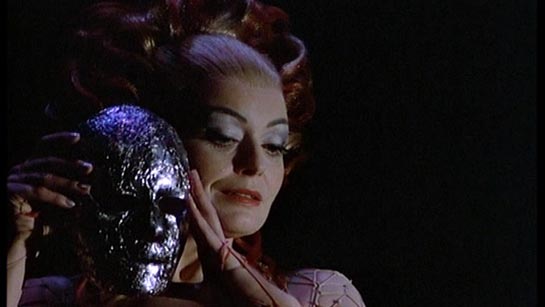
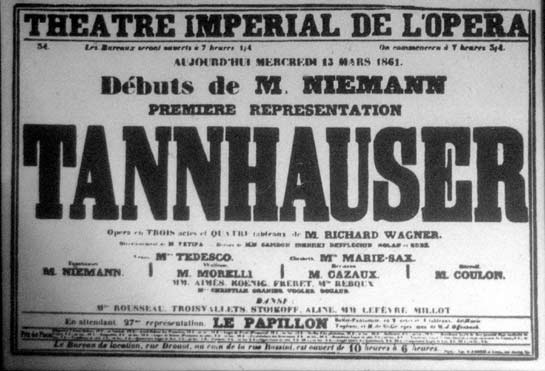
One of the greatest scandals in theatre history occured in Paris in 1861. Wagner refused to place the obligatory ballet in the second act, which the high society members of the so-called Jockey Club required. The members of the Jockey Club would not tolerate this and ruined the performance by causing a riot.
Tannhäuser was first performed at Bayreuth in 1891 with Felix Mottl conducting in Cosima Wagner's production.
Tannhäuser Conductors at Bayreuth Festival >
Tannhäuser was produced in the following cities the first years after the world premiere on 19 October 1845
| 1849 | Weimar (Franz Liszt) |
| 1852 | Schwerin Breslau Wiesbaden |
| 1853 | Leipzig Kassel Posen |
| 1855 | Hannover Karlsruhe Zürich (two performances conducted by Wagner) München |
| 1856 | Berlin |
Said about Tannhäuser
Mark Twain
I saw the last act of "Tannhäuser." I sat in the gloom and the deep stillness, waiting--one minute, two minutes, I do not know exactly how long--then the soft music of the hidden orchestra began to breathe its rich, long sighs out from under the distant stage, and by and by the drop-curtain parted in the middle and was drawn softly aside, disclosing the twilighted wood and a wayside shrine, with a white-robed girl praying and a man standing near. Presently that noble chorus of men's voices was heard approaching, and from that moment until the closing of the curtain it was music, just music--music to make one drunk with pleasure, music to make one take scrip and staff and beg his way round the globe to hear it.
Mark Twain in a Travel letter from Bayreuth
Richard Wagner
Die Ausrüfe: »Ach, erbarm' dich mein!« erfordern einen so durchdringenden Accent, daß er als bloßer wohlgebildeter Sänger hier nicht auskommt; sondern die höchste dramatische Kunst muß ihm die Energie des Schmerzes und der Verzweiflung für einen Ausdruck ermöglichen, der aus den schauerlichsten Tiefen eines furchtbar leidenden Herzens, wie ein Schrei nach Erlösung hervorzubrechen scheinen muß. Der Dirigent hat darüber zu wachen, daß dem Hanutsänger der angedeutete Erfolg durch allerdiskreteste Begleitung der übrigen Sänger, sowie des Orchesters ermöglicht werde. -
Sämtliche Schriften und Dichtungen: Fünfter Band. Richard Wagner: Werke, Schriften und Briefe, S. 2418 (vgl. Wagner-SuD Bd. 5, S. 135)
David Alden
Tannhäuser is a gift for any stage director. The opera is an incredible work of fantasy. It swarms with personal matters and the things he had struggled with all his life. It is a compendium of all those elements that would come along later, and that makes it harder to find a way through the different approaches to the piece and to discover what we consider its quintessence.
David Alden in conversation with Peter Jonas
It's crazy, it's insane, it's sick, it's obsessive.
David Alden in a TV documentary about Tannhäuser and Wagner
Peter Jonas
Tannhäuser is a horrible great mess of an opera. But a wonderful one.
Peter Jonas in a TV documentary about Tannhäuser and Wagner
Charles Baudelaire
It seemed to me that the music was mine, and I recognized it as any man recognizes what he is destined to love.
Charles Baudelaire
Tannhäuser on CD
Jane Eaglen (Elisabeth), Waltraud Meier (Venus), René Pape (Hermann, Landgraaf von Thuringen), Peter Seiffert (Tannhäuser), Thomas Hampson (Wolfram von Eschenbach), Gunnar Gudbjornsson (Walther von der Vogelweide), Hanno Muller-Brachman (Biterolf), Stephan Rugamer (Heinrich der Schreiber), Alfred Reiter (Reinmar von Zweter) & Dorothea Röschmann (Ein junger Hirt)
Chor der Deutschen Staatsoper Berlin & Staatskapelle Berlin
The recording is part of the box set Daniel Barenboim: Complete Wagner Operas (34 CD)
"This must be one of the most opulent recordings made of
any opera. The truly remarkable range, perspective and balance of the sound
is most appropriate for a work conceived on the grandest scale, yet it
retains its focus in the more intimate scenes. The achievement of Barenboim's
Berlin chorus, so important in this opera, and orchestra could hardly be
bettered. The results are, if nothing else, an audio treat, surpassing
the DG version's rather hit-and-miss engineering and the now slightly dated
feel of the Decca.
[…]
The title-role, as many tenors admit, is a real killer. Seiffert is probably
its most telling exponent: his performance that combines vocal assurance
and emotional involvement to create a vivid portrait of the hero torn between
sacred and profane love. The objects of Tannhäuser's attention are impressively
portrayed by Waltraud Meier and Jane Eaglen. Meier makes the most of the
bigger opportunities and brings her customary tense expression to bear
on Venus's utterance, while not quite effacing Christa Ludwig's voluptous
reading for Solti."
The
Gramophone Classical Music Guide 2008
DVD
Kasper Holten: Tannhäuser (Copenhagen). Reviewed by Jerold Diamond
Tannhäuser Overture
Klaus Tennstedt, London Philharmonic, Suntory Hall (Tokyo, Japan)